
Most travel guides die within 18 months. I have watched hundreds of them climb to page one, plateau, then slowly sink as fresher content takes their place. The guides that survive, the ones still pulling traffic five or seven years later, share specific structural and strategic qualities that most content teams overlook entirely.
After building content strategies for DMOs and tourism boards across three continents, I have identified the patterns that separate ephemeral content from durable assets. This is not about writing better prose. It is about engineering content architecture that resists decay.
Why Most Travel Guides Fail the Long Game?
The typical travel guide lifecycle looks like this: publish, rank, celebrate, ignore, watch rankings erode, eventually unpublish or redirect. I see this pattern constantly in site audits for tourism clients.
The root causes are predictable:
- Time-sensitive information mixed with evergreen content in the same sections
- No clear update protocol or content freshness strategy
- Surface-level coverage that competitors can easily replicate and surpass
- Missing internal link architecture that would pass authority over time
- Keyword targeting focused on volume rather than intent durability
When I built the content strategy for CostaRicaDivers.com, I approached every guide with a simple question: will this still be accurate and useful in three years? If the answer was no, I either restructured the content or created a separate section for time-sensitive details that could be updated independently.
The Evergreen Structure That Actually Works
Separating permanent from perishable is the foundation of durable travel content. I use a specific structural approach that I call the Core and Shell method.
The Core: Information That Rarely Changes
Your core content should cover aspects of a destination that remain stable across years:
- Geographic and cultural context
- Transportation infrastructure and general logistics
- Neighborhood or regional breakdowns
- Safety considerations and local customs
- Activity types available (diving, hiking, food scenes)
This core should represent 60 to 70 percent of your guide. Write it with depth that competitors cannot easily match. When I write a dive site guide, I include water temperature ranges across seasons, visibility patterns, current behaviors, marine life by depth, and certification requirements. That level of specificity comes from actually being in the water, not from aggregating other articles.
The Shell: Time-Sensitive Details in Modular Sections
The remaining 30 to 40 percent covers information that changes:
- Specific business recommendations (restaurants, tour operators, hotels)
- Pricing information
- Current visa and entry requirements
- Event calendars and seasonal considerations
- Direct booking links or availability
Structure these as clearly labeled sections or even separate content blocks. I often use a consistent format like “Current Recommendations (Updated [Month Year])” so readers and search engines can immediately identify the freshness of time-sensitive information without questioning the validity of the core content.
Depth Beats Breadth Every Time
I have audited tourism sites where teams proudly showed me 200 destination guides, each around 800 words. Their traffic was declining across all of them. Meanwhile, a competitor with 40 guides averaging 3,000 words each was dominating the same keywords.
Google’s helpful content signals reward comprehensive coverage. For travel guides specifically, depth signals expertise and first-hand experience. When someone searches “best time to visit Monteverde Costa Rica,” they want more than a two-sentence answer. They want to understand the dry season advantages, the green season wildlife activity, the crowd patterns, the price differences, and how cloud forest weather actually behaves.
A shallow guide might rank initially through domain authority or link building, but it will lose to deeper content over time as Google accumulates user engagement signals.
The Depth Checklist I Use
Before publishing any travel guide, I verify coverage of:
- Who this destination or activity is best suited for (and who should avoid it)
- Practical logistics from arrival to departure
- Common mistakes and how to avoid them
- Budget breakdown with realistic ranges
- Timing considerations across different seasons
- What changed recently and what to expect going forward
- Alternative options if this destination does not fit
That last point is critical. Guides that honestly redirect unsuitable visitors to better alternatives actually rank better over time. Google can measure when users return to search results dissatisfied. Helping someone find the right destination, even if it is not yours, reduces pogo-sticking and improves your quality signals.
The Seasonal Update Protocol
Publishing is maybe 40 percent of the work. The other 60 percent is maintenance. I schedule content reviews based on a tiered system:
Tier 1: Quarterly Reviews
For high-traffic guides (top 20 percent by sessions), I review every three months:
- Check all external links for 404s
- Verify business recommendations still exist and maintain quality
- Update pricing if significantly changed
- Add any new information from recent visits or reliable sources
- Refresh the “last updated” date only if substantive changes were made
Tier 2: Bi-Annual Reviews
For middle-tier guides, I review every six months with the same checklist plus:
- Analyze search console data for new keyword opportunities
- Check competitor content for gaps I should fill
- Evaluate whether the guide needs restructuring or expansion
Tier 3: Annual Reviews
For lower-traffic guides, once per year:
- Full accuracy audit
- Decision point: update, merge with another guide, or deprecate
I have seen tourism sites recover rankings on guides that had declined for two years simply by implementing a serious update protocol. One client had a guide to regional wineries that dropped from position 3 to position 14 over 18 months.
We updated business hours, added three new wineries, removed two that had closed, expanded the transportation section, and added a new section on wine tour booking tips. Within six weeks, it was back at position 4.
Internal Linking Architecture for Long-Term Authority
Travel guides should not exist as isolated pages. They need to function as hub pages that connect to and receive links from related content across your site.
The Hub and Spoke Model
Your main destination guide is the hub. Surrounding it are spoke pages covering specific aspects:
- Hub: Complete Guide to Visiting Guanacaste
- Spokes: Best Beaches in Guanacaste, Guanacaste Diving Sites, Guanacaste Dry Season Weather, Where to Stay in Guanacaste, Guanacaste Airport Transportation
Each spoke links back to the hub. The hub links out to each spoke. This creates a topical cluster that signals comprehensive coverage to Google and distributes link equity efficiently.
When I audit tourism sites, I frequently find guides with zero internal links pointing to them. These pages are orphaned in terms of authority flow. Even excellent content struggles to rank when isolated from the site’s link architecture.
Contextual Link Placement
Do not dump all your internal links in a “Related Articles” section at the bottom. Embed them contextually within the content where they provide genuine value.
If you mention transportation options, link to your airport transfer guide right there. If you discuss weather patterns, link to your detailed seasonal guide in that paragraph.
I aim for one contextual internal link per 300 to 400 words in travel guides. More than that starts to feel spammy. Fewer than that wastes link equity opportunities.
Keyword Strategy for Durability
Some keywords are inherently more durable than others. “Best restaurants in Barcelona 2024” has a built-in expiration date. “How to get from Barcelona Airport to city center” will remain relevant for decades unless they build a new airport.
Intent Categories by Durability
High durability (target these as your primary keywords):
- How to get to [destination]
- Best time to visit [destination]
- [Destination] travel guide
- Things to do in [destination]
- [Destination] safety
- [Activity] in [destination] (diving in Cozumel, hiking in Patagonia)
Medium durability (include but do not build your strategy around):
- Best [category] in [destination]
- Where to stay in [destination]
- [Destination] itinerary
Low durability (cover in shell sections, not core):
- [Destination] [year]
- [Destination] COVID requirements (remember those?)
- New [attraction] in [destination]
- [Destination] deals
Search Intent Alignment
Long-lasting rankings require matching search intent precisely. A guide that ranks for “Bali travel guide” needs to comprehensively cover what someone planning a Bali trip actually needs to know. If your guide focuses too narrowly on one aspect, say beaches only, it will lose to broader guides over time as Google recognizes the intent mismatch.
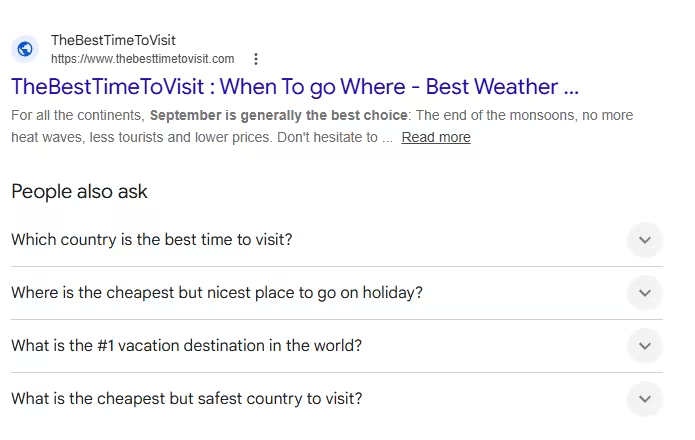
I always search my target keywords manually before finalizing content structure. What are the top three results covering? What questions do People Also Ask show? What related searches appear? Your guide needs to answer all of these while going deeper than competitors on each point.
The First-Hand Experience Advantage
Google’s E-E-A-T framework explicitly values experience. For travel content, this creates a significant advantage for writers who have actually visited destinations over those compiling information from other sources.
I can write about diving in Costa Rica with a level of specificity that no desk researcher can match because I have logged hundreds of dives there. I know that the visibility at Catalina Islands is often better in the morning before the afternoon chop develops. I know that Bat Islands is genuinely dangerous for inexperienced divers despite what some operators advertise. And I know which dive shops maintain their equipment properly and which cut corners.
That kind of detail signals authenticity to both readers and algorithms. If you are writing travel guides without first-hand experience, you are competing at a structural disadvantage against those who have it.
Demonstrating Experience in Content
Do not just claim experience. Demonstrate it through:
- Specific details that only a visitor would know
- Photos you actually took (with proper EXIF data intact)
- Personal anecdotes that illustrate points
- Opinions that could only come from experience (“The sunset view from Point X is overrated because of the power lines. Walk 10 minutes north to Point Y instead.”)
- Author bio with verifiable credentials
Frequently Asked Questions
How long should a travel guide be to rank well?
Word count matters less than comprehensive coverage of search intent. That said, I rarely see travel guides under 2,000 words maintain rankings for competitive keywords over multiple years. My target for main destination guides is 3,000 to 4,500 words. Specific activity guides can work well at 1,500 to 2,500 words. The key is having more depth than competitors while remaining useful rather than padded.
How often should I update travel guides?
It depends on traffic and content type. High-traffic guides need quarterly reviews at minimum. Time-sensitive information like prices and business recommendations should be verified every three to six months. Core evergreen sections might only need annual reviews unless something significant changes at the destination.
Should I include the year in my travel guide title?
Generally no, unless the keyword data strongly suggests users expect it. Adding the year creates an artificial expiration date. Instead, use a “last updated” timestamp that you can refresh with each substantive update. If you must include a year for keyword targeting, plan to update the title and content annually.
How many internal links should a travel guide have?
I aim for one contextual internal link per 300 to 400 words, placed naturally within the content where they add value. A 3,000 word guide should have roughly 8 to 10 internal links. Avoid clustering them all at the end in a “related posts” section. The links should help readers navigate to relevant deeper content as they read.
What is the biggest mistake people make with travel guide SEO?
Publishing and forgetting. I have seen excellent guides lose rankings simply because they were never updated while competitors published fresher content. The second biggest mistake is mixing time-sensitive and evergreen content without clear separation, which makes updates harder and confuses both readers and search engines about content freshness.
Building Content That Lasts
Durable travel guides require upfront structural planning, genuine expertise, comprehensive coverage, and ongoing maintenance. Most content teams focus only on the initial publication and wonder why their guides decay within two years.
The sites dominating travel search have systematized content maintenance. They treat guides as living assets rather than one-time publications. They invest in depth over breadth. They build internal link architecture that compounds authority over time.
If you are managing travel content for a DMO, hotel group, or tourism business and want to audit your existing guides or build a durable content strategy, I would be glad to help. Reach out through my contact page to discuss your specific situation.

About the Author
I’m Peter Sawicki, a Destination SEO Strategist helping tourism brands and DMOs grow their online presence through SEO, technical audits, and creative digital strategies. Over the years I’ve worked across multiple countries and markets, which gives me a global perspective on every project I take on. When I’m not optimizing websites, you’ll most likely find me underwater. Scuba diving is where my two biggest passions meet.